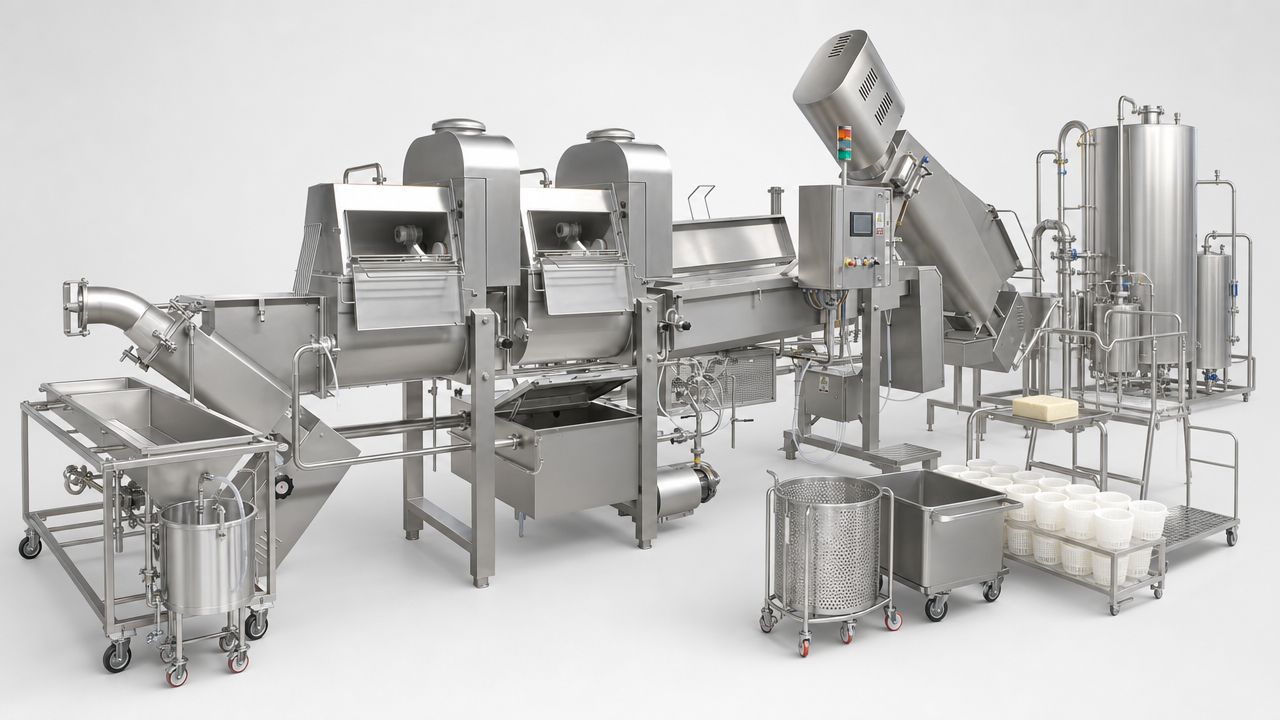
A Cheese Plant converts standardised milk into matured, market-ready cheese. It standardises and pasteurises the milk, cultures and coagulates it with starter and rennet, cuts and cooks the curd, drains the whey, then salts, moulds, presses, ripens, and packs the cheese for distribution.
ATMAN Group designs and executes cheese plants across the full capacity spectrum — from compact 500 L/batch vat lines for artisanal and regional producers, up to large automated cheese lines for major dairies and processed-cheese manufacturers running multiple shifts daily.
Every cheese line draws standardised milk from the upstream milk plant and integrates culturing, ripening, whey handling, and packing — with matched sanitary piping, compatible CIP cycles, and synchronized batch tracking. Plants are FSSAI-compliant by default, with hygienic SS-304 stainless steel construction throughout the wet section per BIS and 3-A sanitary standards.
Cheese is a premium, high-value dairy category — and consistency in culture, coagulation, and ripening is everything. A well-engineered cheese line is the difference between consistent grade and yield and losses from variable set, poor moisture control, and whey give-away. ATMAN’s integrated approach designs the cheese line with ripening and whey valorisation pre-mapped.
Typical Buyers We Work With
ATMAN builds cheese plants for the full B2B dairy spectrum — cooperatives, private dairy brands, processed-cheese makers, HoReCa suppliers, and integrated greenfield projects.
Cooperative dairy federations and unions adding cheese and value-added production. Multi-shift, high-uptime lines.
02
Farmer Producer Organizations
FPOs and regional producers entering branded or artisanal cheese with compact, scalable vat lines designed for first-time entrants.
03
Private Dairy Brands
Established dairy brands launching cheese SKUs or expanding existing cheese capacity into multi-shift operations.
04
Brownfield Expansions
Existing dairy plants adding cheese capacity — vats, presses, brining, and ripening — without disrupting ongoing production.
05
Greenfield Projects
New dairy projects adding cheese as a premium value-added line within an integrated facility from Day 1 — single-vendor turnkey execution.
06
MSME
Upcoming dairy Entrepreneurs aspiring to foray into Dairy business.
11-stage cheese processing flow — ATMAN Group
Cheese Manufacturing — From Milk to Matured Cheese
A cheese plant operates as a continuous flow from milk standardisation to matured, packed cheese. Each stage is engineered for yield, hygiene, and statutory compliance. The full 11-stage flow is shown above. Below, the core stages ATMAN designs and commissions.
01. Milk Reception
Fresh milk received, weighed, and tested for fat, protein, and quality. Chilled and held until the cheese batch begins.
06. Cutting & Cooking
Curd cut into uniform cubes and gently scalded to 38–40°C, expelling whey and firming the curd.
02. Standardisation
Milk standardised to the target fat-to-casein ratio — the key lever for cheese yield, texture, and grade.
07. Whey Drainage
Whey drained and collected for valorisation. Curd matted and allowed to knit (cheddaring) where the recipe requires.
03. Pasteurisation
Milk pasteurised (HTST 72°C or vat) to destroy pathogens and create a clean, consistent base for culturing.
08. Salting & Moulding
Curd milled, salted, and filled into hoops or moulds that shape the cheese into blocks or wheels.
04. Cooling & Culture
Cooled to 30–32°C and inoculated with selected starter cultures that develop acidity and flavour.
05. Rennet & Coagulation
Rennet (coagulant) added; the milk sets into a firm gel over 30–45 minutes, trapping fat and protein.
09. Pressing
Moulded curd pressed under controlled load to expel residual whey and form a sealed, uniform body.
10. Ripening & Packing
Cheese matured under controlled temperature and humidity to develop flavour, then cut, packed, and cold-stored.
ATMAN engineers the full cheese line as one integrated flow — from culturing and coagulation through pressing, ripening, and whey valorisation — sized to your throughput, optimised for cheese yield and grade, and instrumented for batch traceability.
Equipment Scope — Cheese Plant
A complete cheese plant integrates equipment across five systems. Click each category to see what ATMAN supplies, installs, and commissions.
01
Cheese Process Line
The core equipment that pasteurises, cultures, coagulates, cuts, presses, and ripens milk into market-grade cheese.
Cheese Vat with Cutting & Stirring Harps — 500 to 5,000 L
Cheese Press (Pneumatic / Hydraulic) with Hoops & Moulds
Brine Tank & Salting System
Ripening Room with Racks & Climate Control
02
UTILITY & CIP
Hygiene infrastructure and utility connections that keep the line food-safe and statutory-compliant.
CIP (Clean-in-Place) Skid with Acid/Caustic Tanks
CIP Heat Exchanger & Steam Injection
Compressed Air System
Chilled Water Circuit Piping
Boiler Connection Loop
03
Reception and Chilling
Raw milk reception and chilling infrastructure — tanker unloading, weighing, filtration, chilling, and raw-milk storage ahead of processing.
Sanitary Stainless Steel Piping (SS-304).
Raw Milk Reception & Transfer Pumps.
Sanitary Valves & Pneumatic Actuators.
Inline Milk Filter
Flow Meters & Pressure Sensors.
04
MATERIAL HANDLING
Milk storage, cooling, and crate-handling infrastructure — insulated silos, chilled-water cooling, and cold-chain storage.
Insulated Raw & Pasteurised Milk Silos.
Chilled Water (PHE) Cooling System
Crate Handling & Washing System
Cold Storage Chamber Conveyor System
Insulated Cold Storage Doors
05
ELECTRICAL & AUTOMATION
The control nervous system of the plant — manufactured in-house by ATMAN for tighter integration and faster diagnostics.
MCC (Motor Control Center) Panel — In-House Manufactured
PLC-Based Sequence Control.
SCADA Dashboard for Real-Time Monitoring.
Variable Frequency Drives (VFDs)
Electrical Distribution Panel & Cable Tray Network.
06
Data Analytics
This is a flexible section where you can share anything you want. It could be details or some information about your service four.
Selected equipment views from ATMAN cheese plant projects.
Capacity Options — From Compact to Industrial Scale
ATMAN engineers cheese plants across the full capacity spectrum. Pick the tier that matches your projected Year-2 volume — and we engineer headroom for future expansion into your Day-1 build.
Cheese looks simple — culture, set, press. The reality: inconsistent acidity, variable moisture, and poor ripening quietly destroy grade and yield. Cheese-line execution is where engineering depth pays off. Here’s what makes ATMAN the right partner.
Most equipment suppliers stop at the machine. ATMAN engineers the processing core and downstream packing as one system — matched piping, aligned CIP cycles, unified batch tracking. Zero split-vendor finger-pointing.
02
Single-Window Turnkey Execution
Design through commissioning and AMC under one contract. One team to call when the line throws an error at 2 AM. One accountable partner for plant uptime — not a vendor patchwork.
Cheese-making is a craft-meets-engineering discipline. Cheese-specific know-how — culture and acidity control, coagulation and cook curves, moisture and ripening management — is baked into our playbooks since 2008.
05
Compliance-First Engineering
All plants engineered for FSSAI, BIS-rated electricals, GPCB-norm effluent, and 3-A sanitary process design. Statutory audits pass first time — no costly retrofits later.
06
Modular Scalability Built-In
Initial plant designed with utility headroom and floor/ripening-room layout for added cheese capacity. Scale from 500 to 5,000 kg/day by extending — not rebuilding — the line.
Typical 5–9 month execution timeline — 7 phases
Project Execution — From Day Zero to First Cheese Batch
A typical ATMAN cheese plant project runs 4 to 7 months from kickoff to first cheese batch. We execute in seven structured phases with continuous client visibility into each milestone.
Target throughput, product mix, shift pattern, and budget envelope locked. Raw-milk supply, site utilities, and statutory clearances assessed. Output: project scope and budgetary estimate. (1–2 weeks)
02
Process Design & Engineering
Detailed plant layout, cheese vat / press / brine / ripening-room selection, automation logic, electrical SLDs, sanitary piping isometrics, and integration with upstream milk and packing. (3–6 weeks)
03
Equipment Manufacturing & Supply
In-house MCC panel fabrication, sanitary stainless pipework, cheese vats, and CIP station. Procurement and quality inspection of presses, brine systems, ripening racks, and instrumentation. (8–14 weeks)
04
Site Installation
Equipment positioning, sanitary piping erection, electrical wiring, cheese vat and press setup, brine tank and ripening-room installation, CIP station connection. Civil works run in parallel under client scope. (3–6 weeks)
05
Commissioning & Validation
No-load testing, water trial, milk trial, culture and coagulation validation, cook-curve and pressing calibration, yield verification, CIP cycle validation, controls handover. Performance guarantees verified against contracted KPIs.
06
Operator Training & Handover
On-site training for operators, supervisors, and maintenance team. Standard operating procedures (SOPs), troubleshooting guides, and spare parts list handed over. Plant runs under ATMAN supervision for 1–2 weeks before formal takeover.
07
Annual Maintenance & After-Sales
Optional AMC covering preventive maintenance, spares supply, remote diagnostics, and emergency response. ATMAN remains your single point of contact through the plant’s operational life — not just up to commissioning.
Where ATMAN Has Delivered Cheese & Adjacent Coagulation Plants
ATMAN’s cheese-family experience is built on the same coagulation, curd-handling, brine and cold-chain systems we deliver on paneer and curd plants — for cooperative federations and NDDB-commissioned projects. Below are the closest executed references.
A detailed project portfolio with client names, line capacities, commissioning timelines, and reference contacts is available on request to qualified buyers. Reach out via the project enquiry form below to receive liquid milk processing references relevant to your specific throughput, product mix, and geography.
Cheese Plant — FAQ
Cheese plant capex depends on capacity, cheese type, automation, and ripening infrastructure. A compact vat line can start in the low tens of lakhs; a larger automated line with brining and climate-controlled ripening runs into crores. Share your target output and cheese type and we’ll return an indicative budget after a short feasibility discussion.
Typically 4 to 7 months from kickoff to first cheese batch, depending on capacity, ripening-room build, and approvals. Matured cheeses then need their ageing period (weeks to months) before sale.
Match capacity to your assured milk supply plus 20–30% headroom — hard-cheese yield is roughly 10% of milk intake (about 1 kg cheese per 10 kg milk). Start with a vat line sized for Year-2 demand and add capacity by extending rather than rebuilding.
Mandatory: FSSAI licence (central or state by turnover), GPCB / state pollution-board consent, municipal NOC, factory licence, fire NOC, and electricity sanction. Recommended: ISO 22000, HACCP, and BIS where applicable. ATMAN engineers plants for full compliance by default — no costly retrofits after commissioning.
Footprint scales with output and includes a dedicated ripening room — roughly 1,200–2,500 sq.ft. for small lines up to 6,000+ sq.ft. for larger plants. Add space for milk reception, brining, cold storage, packing, and whey handling — total site is usually 1.5–2× the core area.
The same line can make a range — paneer, mozzarella, cheddar, and processed cheese — by changing culture, coagulation, cook curve, and ripening. ATMAN configures the vat, press, brine, and ripening room around your target cheese portfolio.
Take Action Now
Ready to Build Your Cheese Plant?
Turnkey dairy plant projects since 2008. Led by former AMUL senior engineering leadership. Share your project brief — we’ll respond with capacity options, indicative budget, and timeline within 24 working hours.
ATMAN designs and commissions the PLC, HMI and SCADA controls for the cheese plant in-house on Siemens — vat batch sequencing, recipe management and CIP — so process, automation and electrical sit under one contract. For running plants, we upgrade legacy controls and add automation without rebuilding the line. See our dairy plant automation services.
ATMAN supplies, fabricates and integrates the full equipment scope in SS-304 sanitary construction with automatic PLC/SCADA control — turnkey dairy plants across India.
Available across IndiaTurnkey dairy plants — designed, supplied, installed & commissioned across 32 states & UTs.