PLC & SCADA PROJECT
A PLC & SCADA project ties field instruments, PLCs, drives and SCADA/HMI into one automated, monitored and repeatable process line. At ATMAN Group, we design, program, panel-build, install and commission complete PLC & SCADA projects in-house — as a single-window industrial automation partner since 2008, with AMUL-trained engineering leadership behind us. You get one accountable team for the control philosophy, panels, software and commissioning, not a patchwork of vendors.
What a PLC & SCADA Project Delivers
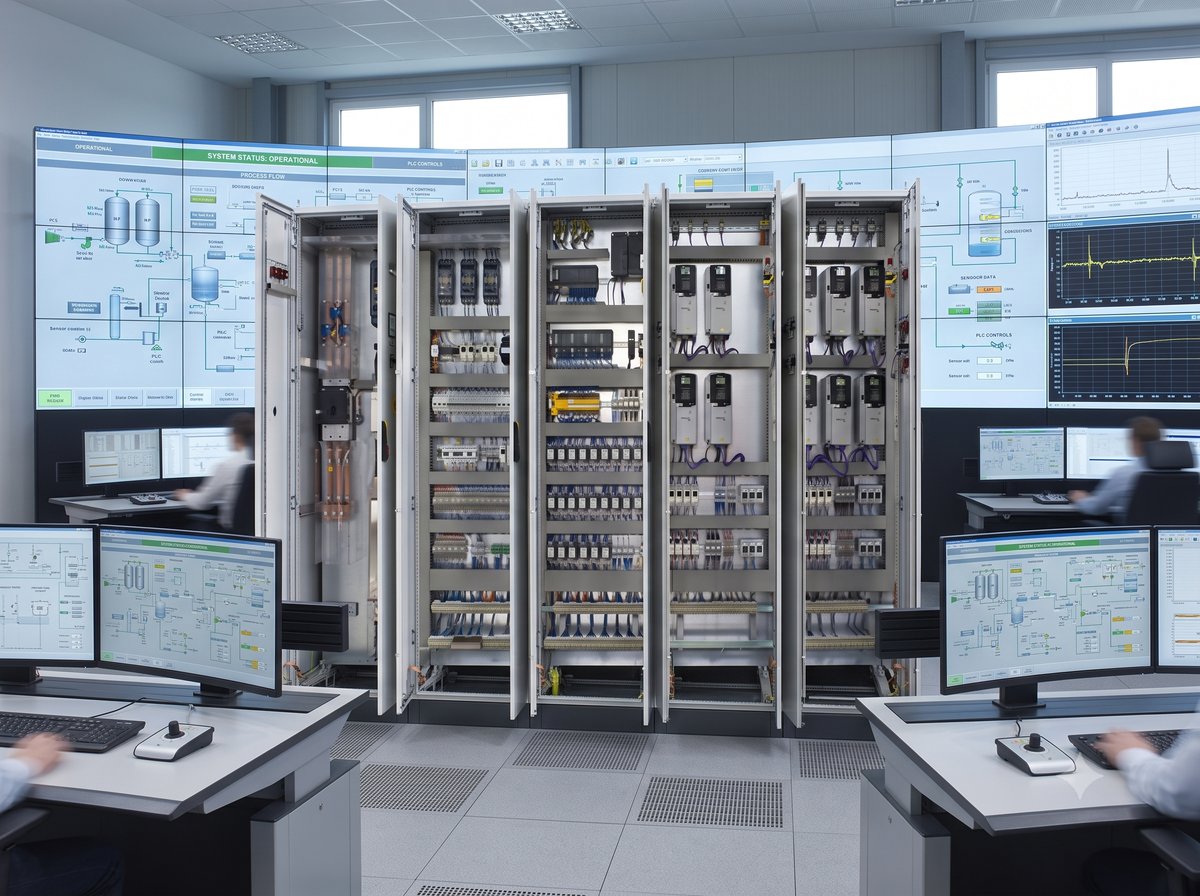
We take your process from control philosophy to a running, monitored line: PLC hardware selection and programming, SCADA/HMI development, MCC and PLC panel engineering, supply and testing, field instrumentation, and installation and commissioning — engineered as one integrated system with full documentation and traceability.
Our PLC & SCADA Scope
- PLC programming across major platforms — Siemens, Allen-Bradley, Mitsubishi, Delta.
- SCADA and HMI development — dashboards, alarms, trends, batch reports.
- MCC / PLC / control panels engineered, supplied and tested before dispatch.
- VFD and motor-control integration, field instrumentation and I/O.
- Installation, commissioning, operator training and after-sales support.
Industries We Automate
- Dairy and food processing plants.
- Pharma, chemical and process industries.
- Water treatment, ETP and utilities.
- Packaging and material-handling lines.
Why ATMAN for Your PLC & SCADA Project
- In-house process, automation and electrical — programming, panels and SCADA built under one roof, faster and with lower vendor markup.
- Single-window accountability — design → programming → panels → installation → commissioning → after-sales under one contract.
- Proven on turnkey process and dairy plants for cooperative federations and NDDB-commissioned builds.
- ISO 9001:2015 certified, BIS-rated electricals, compliance-ready engineering.
What Is Actually Inside a PLC & SCADA Project
Automation quotations are notoriously hard to compare because suppliers include different things and rarely say which. Here is the full list of what a complete project contains, so you can check any bid against it — including ours.
| Stage | What it produces | Frequently left out of quotations |
|---|---|---|
| Survey and study | What exists, what it does, what is obsolete | Almost always, on retrofits |
| Functional design specification | Agreed description of behaviour, modes, interlocks, alarms | Very often — and it is the root of most disputes |
| Hardware design | Controller sizing, I/O strategy, network architecture | Rarely |
| Panel design and build | Drawings, build, wiring, testing | Sometimes split to another vendor |
| PLC software | Sequences, interlocks, diagnostics | Rarely |
| SCADA / HMI configuration | Screens, alarms, trends, users, reports | Screen count is often capped without saying so |
| Alarm rationalisation | A usable alarm system rather than a full one | Nearly always |
| FAT | Witnessed test before shipment | Often “internal testing” instead |
| Installation supervision | Someone competent on site during install | Frequently priced as extra |
| Commissioning and SAT | Proven operation on the real plant | Included, but the number of site days rarely is |
| Interlock proving | Physically tested, recorded | Nearly always assumed |
| Operator training | Your team able to run it | Often one afternoon |
| Documentation and source | Drawings, tag list, functional description, unlocked code | The most commonly missing item — see who owns your PLC program |
| Post-commissioning support | Cover through the first production cycles | Usually a separate contract — see AMC |
The Three Ways These Projects Are Bought
| Model | How it works | Suits | Watch for |
|---|---|---|---|
| Turnkey | One party takes the whole scope and the interfaces | Plants without in-house automation staff | Scope must be defined properly or the price is guesswork |
| Supply and commission | Supplier provides panels and software; you handle install and site work | Plants with a capable maintenance team | The gap between “supplied” and “working” is where disputes live |
| Time and material | Engineering charged by the day | Small changes, support, undefined scope | Poor fit for a whole project — no one owns the outcome |
Most process plants are better served by turnkey, for one reason: on a split contract, integration failures have no owner. When new equipment works, old equipment works, and the two together do not, a split contract makes that your problem to resolve between vendors.
What Actually Drives the Price
Automation is priced on engineering hours, not on hardware. Knowing what moves the number lets you control it deliberately instead of discovering it in a revision.
- I/O count — the crudest but most reliable first indicator
- Number of controllers and panels, and how far apart they sit
- Sequence complexity — a CIP skid with recipes is many times the work of a transfer pump
- Number of SCADA screens, and how much bespoke graphics work each needs
- Interfaces to third-party equipment — each one is a small project of its own, and undocumented ones are the most expensive lines in any automation bid
- Redundancy, where it is genuinely required
- Site days — travel, accommodation and waiting time on a plant that is not ready
- Documentation standard — a properly documented handover costs real hours and saves multiples later
- Compliance and validation requirements, where applicable
How to Compare Bids That Look Nothing Alike
This is the buyer’s real problem. Three quotations arrive at three prices with three different structures and no common basis. A practical method:
- Issue the same scope document to everyone. Even a rough one. Without it you are comparing three different projects
- Require the same line items — use the stage table above
- Ask for site days explicitly, and what happens if more are needed
- Ask what is excluded. The most informative question in any automation tender, and the one most bidders answer vaguely
- Ask who owns the source code, and whether it is unlocked
- Ask what documentation is delivered, by name
- Ask who is on site during commissioning — the engineer who wrote the code, or a junior with a phone number
- Ask about support after handover, with a response commitment in hours
Any bidder who answers all eight clearly is worth talking to, whatever their price. A bidder who cannot has not planned the project — they have priced a guess, and the difference will surface as a variation.
Where Automation Projects Go Wrong
| Failure | Root cause | Prevention |
|---|---|---|
| Scope disputes | No functional specification agreed | Write and sign the FDS before any code |
| Commissioning overrun | Plant not ready, or faults found that should have been caught at FAT | Real FAT, witnessed, plus a written site-readiness checklist |
| Alarm system unusable | Everything alarmed, nothing prioritised | Alarm rationalisation as a defined deliverable |
| Nobody can maintain it | No documentation, locked code | Contract source code and documentation as deliverables |
| Operators resist the system | Screens designed without them | Involve operators in screen design, train on the live system |
| Integration falls between vendors | Split contract with no interface owner | Single contract, or one named party accountable for interfaces |
| Overruns on retrofit | Priced from drawings that do not match the plant | Survey first — see retrofit |
What Actually Takes the Time
Buyers usually assume programming is the long pole. It rarely is.
- Agreeing the specification — needs your team’s attention, and they are running a plant. This is the most common cause of slip, and it is on the client side more often than the supplier’s
- Hardware procurement — lead times on controllers and components move with the market
- Panel build and testing
- Programming and configuration — usually the most predictable phase
- FAT and correction
- Waiting for a shutdown window — on a running plant this frequently dominates everything else
- Commissioning, which is short if FAT was real and long if it was not
Because most of the programme runs while your plant operates normally, the number that matters commercially is not the project duration — it is the outage hours. Ask for those separately, in writing.
What to Insist On in the Contract
- Source code, unlocked, as a named deliverable
- Documentation listed by name — drawings, I/O schedule, tag list, functional description, alarm register, interlock records
- Witnessed FAT with acceptance criteria written in advance
- Site days quantified, and the rate for additional ones
- Interlock proving records as a handover condition
- Defect liability period with a response commitment in hours, not “reasonable endeavours”
- Backups delivered and a restore demonstrated before final acceptance
- Training delivered and recorded
None of these are unreasonable and none of them cost a competent supplier anything to agree. Reluctance on any of them is information.
Greenfield or Retrofit — Different Projects Entirely
| New plant / new line | Retrofit to a running plant | |
|---|---|---|
| Constraint | Budget and schedule | Production — the plant cannot stop |
| Design basis | Clean sheet | What is actually installed, which the drawings will not tell you |
| Biggest risk | Scope creep | Undocumented legacy equipment and the tie-in window |
| Critical first step | Specification | Survey, then specification |
| Commissioning | Continuous | Fitted into shutdown windows |
Most enquiries we receive are retrofit. If yours is, see plant modernization and retrofit and Siemens PLC migration.
Who You Need in the Room
Automation projects succeed or fail on the client side as much as the supplier side, and the difference is usually who was involved and when.
- Production — they know how the plant is actually run, including the workarounds nobody documented
- Maintenance — they will own it afterwards, and they know what fails
- Quality — where records and traceability requirements come from
- One decision-maker who can settle scope questions without a committee
- An operator or two at screen design and again at training
Frequently Asked Questions
Which PLC and SCADA platforms do you work with?
We program Siemens, Allen-Bradley, Mitsubishi and Delta PLCs and build SCADA/HMI on leading platforms, chosen to fit your process and budget.
Can you handle the panels and field work too?
Yes — we engineer and supply the MCC/PLC panels as part of the project, test them before dispatch, and handle instrumentation, installation and commissioning as one turnkey scope.
Do you automate existing (brownfield) plants?
Yes — we retrofit and upgrade automation on running plants with minimal disruption.
Planning a PLC & SCADA project? Share your process scope — our automation engineers will respond with a solution outline, budgetary estimate and timeline. Explore our full Industrial Automation capabilities or request a consultation.
Discuss Your PLC & SCADA Project
Share your process description, I/O count and preferred platform. Our engineers will come back with a scope covering functional design specification, sequence programming, SCADA screens, factory acceptance testing and commissioning.