PLC PROGRAMMING SERVICES
PLC programming is the logic that runs your plant — and its quality decides uptime, safety and throughput. At ATMAN Group, our in-house engineers write, test and commission PLC programs across major platforms as part of a single-window industrial automation service since 2008, with AMUL-trained engineering leadership behind us.
What Our PLC Programming Covers
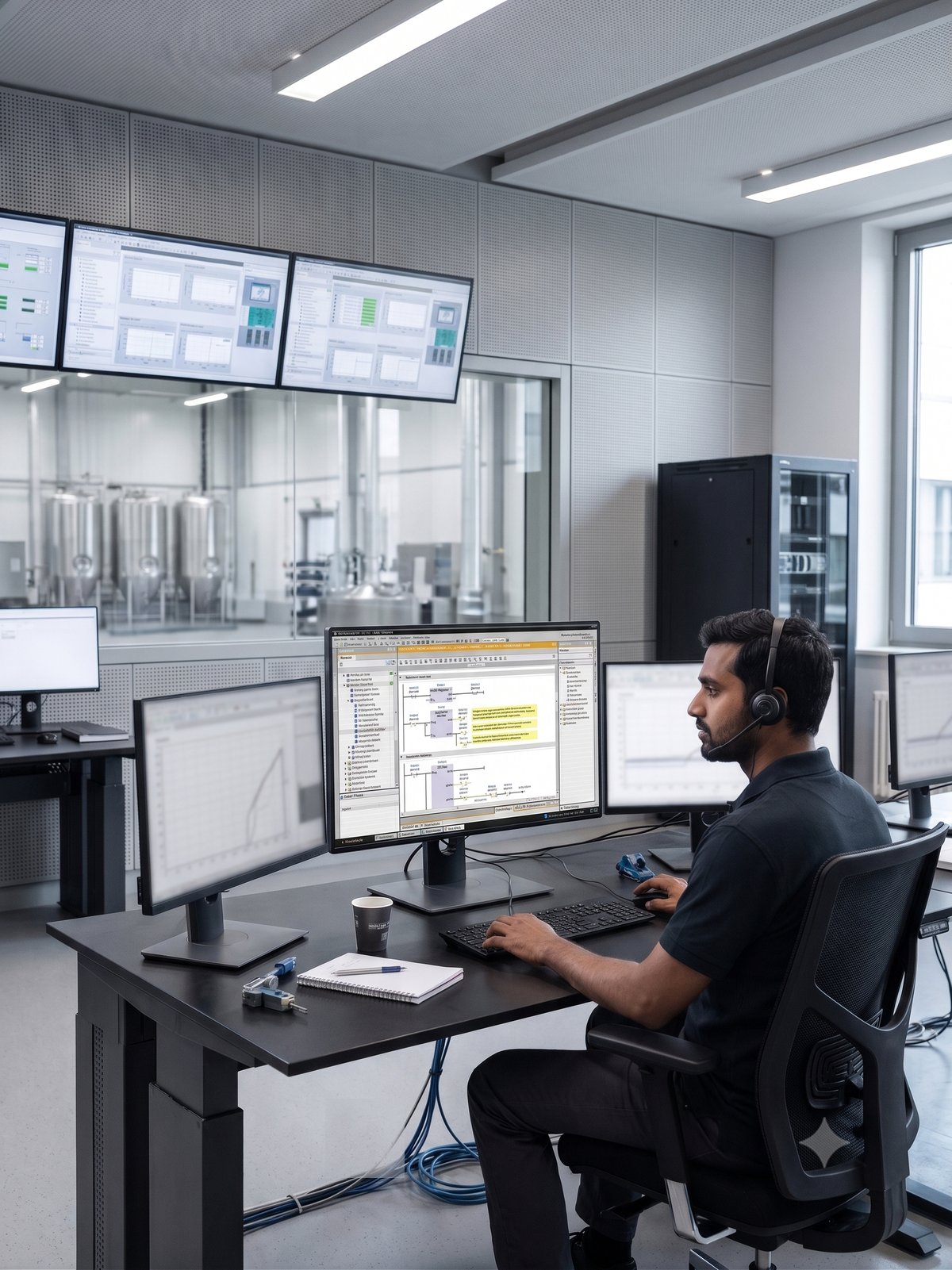
From control philosophy to commissioned logic: I/O mapping, ladder and structured-text programming, interlocks and safety logic, sequencing, recipe and batch control, and SCADA/HMI integration — all documented and version-controlled for easy maintenance.
Platforms We Program
- Siemens — our core platform and deepest expertise. S7-1200 / S7-1500, legacy S7-300 / S7-400, TIA Portal, STEP 7, WinCC and WinCC Unified — new systems, programming, modifications and migrations.
- Allen-Bradley, Mitsubishi, Delta and other major makes. Programming, modifications, troubleshooting and upgrades on the platform your plant already runs, as well as complete turnkey projects — including migration from any make to Siemens.
- SCADA/HMI integration — WinCC, and other leading platforms.
Applications
- Process sequencing and interlocks for dairy, food and chemical lines.
- Recipe and batch control with traceability.
- CIP, utilities and effluent automation.
- Retrofit and re-programming of legacy PLCs.
Why ATMAN for PLC Programming
- In-house engineers — programming, panels and electrical under one roof.
- Single-window accountability from logic to commissioning and after-sales.
- Proven on turnkey dairy and process plants for cooperatives and NDDB-commissioned builds.
- ISO 9001:2015 certified, documented, maintainable code.
What Separates PLC Code That Works From PLC Code You Can Live With
Almost any competent programmer can make a machine run. The difference shows up two years later, when something breaks at 11 p.m. and the person standing in front of the panel is not the person who wrote the program.
| Code that merely works | Code you can live with | |
|---|---|---|
| Structure | One long routine, written in the order the machine was built | Modular blocks per equipment item, reusable and named |
| Naming | M0.1, T37, DB12.DBX4.2 | Tags that say what they are, matching the drawings and the SCADA |
| Comments | None, or written for the author | Written for the next engineer, including why, not just what |
| Fault handling | The machine stops and shows a generic error | The fault is identified, logged, and the operator is told what to check |
| Changes | Every edit risks breaking something unrelated | Change one block, test one block |
| Ownership | Password-protected, only the original supplier can edit | You hold the source, unlocked, and can appoint anyone |
The right-hand column costs slightly more to write and dramatically less to own. Over a machine’s life the difference is not close.
Who Owns Your PLC Program?
This deserves a section of its own, because it is where plants get quietly trapped and almost nobody asks about it before signing.
It is common practice for an integrator to hand over a running machine and keep the program locked — protected blocks, no source, no documentation. The plant then discovers, sometimes years later, that no other supplier can touch the system. Every future change, however small, goes back to one company at whatever rate they choose, and if that company closes or loses interest, the plant is left reverse-engineering its own machine.
Before you sign any automation contract, ask three questions in writing: do we receive the source code, is it unlocked, and is documentation included? If any answer is no, price the consequence into the bid.
The Specification Comes Before the Code
Most disputes on automation projects trace back to nobody writing down what the machine was supposed to do. The plant assumed one behaviour, the programmer implemented another, and both were reasonable readings of a conversation.
- Functional design specification — modes of operation, sequences, interlocks, alarms, operator actions, recipes
- I/O schedule agreed against the drawings before programming starts
- Exception handling defined deliberately — what happens on power failure, air failure, sensor failure, mid-sequence stop, and emergency stop recovery. This is where thin specifications fail, because it is the part nobody thinks about until it happens
- Acceptance criteria written down, so “finished” is a test result and not an opinion
On a retrofit, this stage doubles as archaeology — the specification has to be reconstructed from a running plant. See Siemens PLC migration.
Interlocks Are the Part That Matters
Sequencing makes a machine productive. Interlocks stop it hurting somebody, wrecking equipment, or sending product to the wrong place. They are also the part most often written quickly and never reviewed again.
- Every interlock is documented with its reason, so a future engineer knows what he is removing before he removes it
- Fail-safe direction is deliberate — what a valve does on loss of air, loss of power, loss of signal is a decision, not a default
- Product-path protection — a wash route can never open into a line holding product; that is a safety function, not a convenience
- Interlocks are proved at commissioning, physically, with a witnessed record. An interlock nobody has tested is an assumption
- Safety functions stay in the safety system where one is required. Standard PLC logic is not a substitute for a safety relay or a safety controller, and we will say so rather than accept a cheaper scope
Diagnostics — Writing Code That Explains Itself
Downtime is rarely the repair. It is the hour spent working out what went wrong. Good PLC code cuts that hour down, and it is a design choice made while writing, not something added later.
- Specific faults, not general ones. “Valve 214 failed to confirm open within 5 seconds” beats “Sequence fault”
- First-out capture, so a trip reports its cause instead of forty consequences
- Step numbers visible — an operator can say where the sequence stopped without a laptop
- Run hours and cycle counts for equipment that will need planned maintenance
- Timing captured, so a slow step is visible before it becomes a stopped step
Testing Before It Reaches the Plant
- Simulation — the logic exercised against simulated I/O, including the failure cases, on the bench
- Internal review by an engineer who did not write it
- Factory Acceptance Test that you witness, against the specification, before anything is shipped
- Site Acceptance Test with the real plant, real instruments and your operators present
- Witnessed interlock proving, recorded
- Operator training on the running system
A fault found in simulation costs an hour. The same fault found during commissioning costs production, and found after handover it costs trust as well.
Where Siemens Depth Matters
Our depth is Siemens — TIA Portal, the S7-1500 family, WinCC and WinCC Unified. Concentration on one platform buys things that breadth does not:
- Reusable, proven block libraries — valves, motors, PID loops, CIP steps already written and tested rather than reinvented per project
- A consistent house standard, so your third project reads like your first and any of our engineers can pick it up
- Real knowledge of platform behaviour — the quirks, the diagnostics, the things that only show up on a live plant at 2 a.m.
- Migration capability from legacy Siemens hardware, which is where a large share of Indian process plants currently sit
Where a plant carries mixed hardware we will say plainly what we will and will not commit to, rather than accepting scope we cannot properly serve.
The Four Situations We Are Usually Called Into
| Situation | What it actually needs |
|---|---|
| New line or machine | Specification, programming, FAT, commissioning, training — the full sequence |
| Adding to an existing system | Understanding the current program before touching it. The risk is not the new code, it is what the new code disturbs |
| Inheriting somebody else’s program | Read-out, documentation and a functional description reconstructed from the code. Common, and normal — it is not a reason to start over |
| Nobody can maintain what we have | Audit, document, restructure where it pays, and hand back an unlocked system your team can actually own |
The last two are the majority of enquiries, and both start with reading before writing.
What You Receive at Handover
- Source program, unlocked, in the current project format
- Exported tag list aligned to the drawings and the SCADA
- Functional description — what the program does, in words your maintenance team can read
- I/O schedule and as-built drawings
- Interlock register with reasons and test records
- Alarm list with priorities and operator actions
- Backups, with a restore actually demonstrated rather than assumed
- Training records
Ongoing cover afterwards is available under an automation support contract.
Frequently Asked Questions
Can you re-program or upgrade our existing PLC?
Yes — we audit, re-program and upgrade legacy PLCs, and migrate to current platforms with minimal downtime.
Do you provide documentation?
Yes — I/O lists, logic documentation and version control are standard, so your team can maintain the system.
Can you integrate SCADA/HMI as well?
Yes — we develop SCADA/HMI and integrate it with the PLC as one commissioned system.
Need PLC programming for a new line or an upgrade? Share your process and platform — our engineers will respond with a scope, estimate and timeline. Explore our full Industrial Automation capabilities or request a consultation.
Discuss Your PLC Programming Requirement
Whether it is a new sequence, a migration off an obsolete CPU, or fixing logic nobody has documented, tell us the make and model and we will come back with a scope and a realistic timeline.