CONTROL & INSTRUMENTATION AUTOMATION
Control and instrumentation (C&I) automation is the measurement and control backbone of a modern plant — the field instruments, control loops, PLCs and SCADA that keep your process accurate, safe and repeatable. At ATMAN Group, we engineer complete C&I automation in-house — as a single-window industrial automation partner since 2008, with AMUL-trained engineering leadership behind us.
What C&I Automation Covers
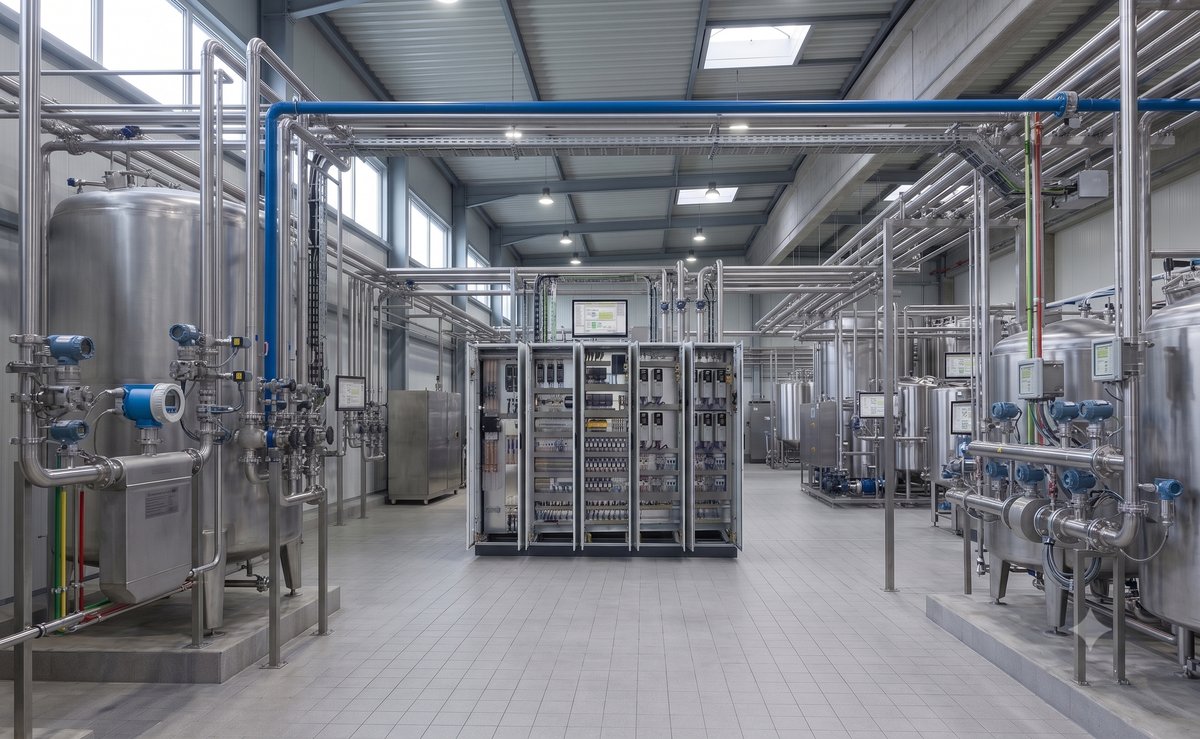
From instrument selection to closed-loop control: field instrumentation (flow, level, temperature, pressure, pH), control valves, PLC-based control loops (PID), interlocks and safety, and SCADA integration — designed, installed and commissioned as one system.
Our C&I Scope
- Field instrumentation — flow, level, temperature, pressure, analytical.
- Control valves, actuators and final control elements.
- PLC control loops, PID tuning, interlocks and safety logic.
- Instrumentation panels, cabling and loop checking.
- SCADA integration, calibration, commissioning and support.
Applications
- Dairy, food and beverage process control.
- Pharma and chemical process instrumentation.
- Water/ETP, utilities and boiler control.
- Retrofit and upgrade of legacy instrumentation.
Why ATMAN for C&I Automation
- In-house process, instrumentation, automation and electrical under one roof.
- Single-window accountability from instrument to SCADA and commissioning.
- Proven on turnkey dairy and process plants for cooperatives and NDDB-commissioned builds.
- ISO 9001:2015 certified, compliance-ready engineering.
Control Is Only Ever as Good as the Measurement
A control system cannot be better than what it is told. A PID loop fed by a badly installed sensor will hold a wrong number very precisely, and everyone will trust it because it appears on a screen. Most “the automation is not working” complaints turn out, on inspection, to be measurement problems.
- A drifting sensor nobody has calibrated in three years, quietly moving your process off target
- A thermowell inserted too shallow, reading the pipe wall rather than the product
- A flow meter installed with no straight length upstream, reading turbulence
- A signal cable run alongside a VFD output, picking up noise that looks like process variation
- An instrument specified for the wrong range, so the operating point sits at 3% of span with no useful resolution
Choosing the Instrument for the Duty
| Measurement | Common options | What decides it |
|---|---|---|
| Flow | Magnetic, Coriolis, ultrasonic, vortex | Conductivity of the fluid, whether true mass is needed, whether payment or yield depends on it. Where money is decided, Coriolis mass flow is the defensible choice |
| Level | Hydrostatic, radar, ultrasonic, load cells | Foam, agitation, CIP spray interference, vessel geometry. Foam defeats several technologies that look fine on paper |
| Temperature | PT100 with thermowell | Insertion depth, response time, and whether duplex sensing is needed where the reading is legally significant |
| Pressure | Flush diaphragm, gauge or differential | Hygienic connection, crevice-free, cleanability |
| Conductivity | Toroidal or contacting | CIP phase detection and rinse endpoint — the measurement that saves the most water in a dairy |
| pH | Combination electrode | Maintenance discipline. pH is the highest-upkeep instrument in the plant and is often installed and then abandoned |
| Analytical (fat/SNF) | Inline analysers | Where standardisation or payment depends on it |
The cheapest instrument that meets the duty is the right one. The cheapest instrument that does not is the most expensive thing on the P&ID, because everything downstream of it is wrong.
Where It Is Installed Matters as Much as What It Is
Instrument selection gets attention in the specification; installation detail rarely does. It is where accuracy is actually lost.
- Straight lengths upstream and downstream of flow meters, per the manufacturer — not per what fits in the available space
- Thermowell insertion depth sufficient to read the product, oriented into the flow
- No dead legs. In a hygienic plant a dead leg is both a measurement error and a contamination risk
- Drainable and CIP-able — an instrument that cannot be cleaned in place will eventually be bypassed
- Accessible for calibration without scaffolding, or it will not be calibrated
- Isolation valves so an instrument can be replaced without draining the line
Hygienic Design for Dairy and Food
- Product-contact materials and surface finish appropriate to food contact
- Hygienic process connections rather than threaded fittings in product lines
- Crevice-free, self-draining installation — no horizontal pockets holding product through a wash
- Withstands CIP chemistry and temperature, cycle after cycle, not once
- Documented, because an auditor will ask what is in contact with product and expect an answer with certificates
For the wash regime these instruments must survive, see dairy plant automation.
Calibration, Drift and Records
An uncalibrated instrument is an opinion with a display. Drift is slow and invisible, which is exactly what makes it dangerous — the plant moves off target gradually and everyone adapts to the wrong number.
- A calibration schedule by criticality, not one blanket interval for everything
- Records with traceability — as-found and as-left values, so drift is visible over time rather than silently corrected
- Tight discipline on legally significant measurements — pasteurisation temperature, reception quantity
- Verification built into the control system where possible: two independent measurements that should agree, alarming when they diverge
- Calibration status visible, so an operator knows whether to trust a reading
As-found readings are the valuable ones. If an instrument is routinely found well out of tolerance, the interval is wrong or the installation is.
Signal Integrity — Where Good Instruments Go Wrong
- Signal cable segregated from power, and never run alongside VFD output cabling. Drives are the single most common source of instrument noise in a process plant
- Screened cable, earthed at one end only — earthed at both ends creates the loop it was meant to prevent
- A single-point earthing philosophy for the instrument system, decided and documented
- 4–20 mA remains robust and diagnosable; a reading of 0 mA is a broken loop, not a zero measurement, and that distinction matters
- Digital protocols where the diagnostics justify them, not because they are newer
- Loop-checked at commissioning, every point, field to screen, and recorded
Loop Tuning
A loop that oscillates gets put into manual, and once in manual it stays there. The plant then runs on operator attention instead of control, which works until the shift changes.
- Verify the measurement first — see above. Tuning around a bad sensor is wasted effort
- Check the final control element — a sticking valve or a worn positioner cannot be tuned out
- Tune for the actual operating range, not one convenient setpoint
- Handle the practicalities — bumpless transfer, sensible output limits, anti-windup on integral action
- Record the parameters so the next engineer inherits a starting point rather than a mystery
- Review loops in manual periodically. Every loop sitting in manual is a control system not doing the job it was paid for
What to Instrument — and What Not To
More instruments is not better. Every one is capital, calibration, spares and another thing to fail.
- Instrument what you control — the loop needs it
- Instrument what you must prove — auditors, customers, payment
- Instrument what you cannot afford to discover late — the excursion that spoils a batch
- Instrument what pays for itself — energy per unit, yield, the numbers that fund the next project
- Do not instrument what nobody will look at, act on, or maintain
On retrofits the answer is often that fewer, better-placed instruments beat more of them. Where the aim is visibility rather than control, see plant monitoring and dashboards.
Frequently Asked Questions
Do you select and supply the instruments too?
Yes — we specify, supply, install, calibrate and commission field instrumentation as part of the C&I scope.
Can you tune existing control loops?
Yes — we audit and tune PID loops and upgrade instrumentation to improve stability and accuracy.
Do you integrate C&I with PLC/SCADA?
Yes — instrumentation, PLC control and SCADA are delivered as one integrated system.
Planning control and instrumentation automation? Share your process and control needs — our engineers will respond with a scope, estimate and timeline. Explore our full Industrial Automation capabilities or request a consultation.
Discuss Your Instrumentation Requirement
Share your measurement points and accuracy requirement and we will come back with an instrument schedule, hook-up drawings and loop diagrams. On-site calibration and HART configuration are handled by our own team.